Not a name I chose, but one many people have begun to use: the Queen of Angel Island. Some simply call it Erika’s Island because I have swam it 8 times. It makes me blush, and I am honored by the recognition. From the very first time I swam the circumnavigation of Angel Island, I fell in love. I have hiked Angel Island, run a trail race there, biked it, and watched it from San Francisco on cloudy days, foggy days when she is barely visible, and glorious sunny days when she seems to beckon you to visit—or, in my case, swim to her. Some days the wind is relentless, blowing hard through the Golden Gate and whipping up whitecaps across the bay. Other days the wind is light and the water calm and glassy. And then there is everything in between.
As one of the busiest shipping channels in the world, the bay sees tankers constantly moving through the deep channel between Alcatraz and Angel Island. These massive ships—three football fields long and up to 20 stories tall—glide quietly through our bay at any hour of the day. And they stop for no one. Then there are the San Francisco Bay currents, which can be relentless even on the best of days. There is also the cold water to contend with: bay temperatures range from 50 degrees in the dead of winter up to 64 degrees in September and October. Then there are the critters. We have seals, sea lions, jellyfish, and yes, some sharks—but I prefer not to talk about them, ever. And someone did bring up the great white seal attack off the east side of Alcatraz a few days before my 8th Angel Island attempt. There is a reason this swim is part of the Marathon Swimmers Federation’s “Toughest 13.”
When planning to swim Round Trip Angel Island (RTAI), you look for dates when the current is relatively light, because this swim requires crossing four shipping channels—something that is virtually impossible on most days of the month. Choosing the right date is within your control. Your training leading up to the event and your mental toughness are within your control most of the time. Mother Nature controls the wind, which is a huge factor. You cannot control the friendly critters, the water temperature, or the container ships.
Tom Linthicum (aka Reptile) and I selected May 10th, 2026, as our date to swim Angel Island. Our route was set to go clockwise around the island, with the jump about an hour and a half before slack to flood (incoming tide). The maximum flood of 0.8 mph was expected around 3:50 a.m., and the hope was to make it through what I refer to as Leg 1 and Leg 2 by 3:00 a.m. If you have any desire to swim RTAI, breaking the swim into the six legs I outline is incredibly helpful.
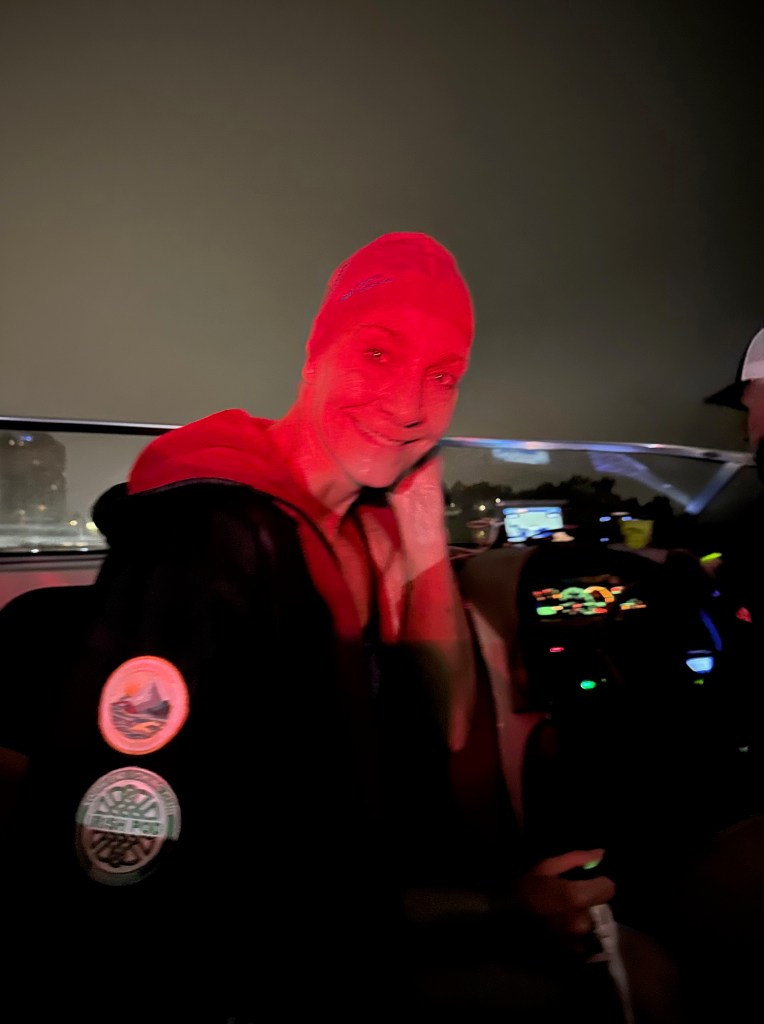
Getting ready to jump off the boat in the wee hours of the night. A little lube to prevent chaffing. There was no need for sunblock since it was a night swim. Cap, goggles, regular bathing suit and wax ear plugs and I am ready to jump in for my 8th Round Trip Angel Island attempt.
Leg 1 is when you leave the beach at Aquatic Park and swim to Alcatraz. I jump from the boat wearing just a bathing suit, swim cap, clear goggles, and wax earplugs, then swim to shore, completely exiting the water to be signaled to start by a red and green traffic glow stick. This is typically the easiest leg of the swim because you are excited, a little nervous, fresh, and ready to go. And you know it’s just Alcatraz. I had easily swum 50+ Alcatraz crossings, so this was no big deal. But in the wee hours of May 10th, at midnight, the wind was blowing hard and I was more nervous than usual. I tend to pick jump times between midnight and 2:00 a.m. because you want to be off the water by 10:00 a.m. Winds tend to calm at night, but that was not the case at all for this swim. Even the protected Aquatic Park cove was choppy from the start. My team—Kim Pross as crew, Michael Tschantz Hahn as observer, and John Grudstad as my kayaker—had to bundle up and get ready for a long, bouncy night. It can be just as hard on the crew when they are stuck on a boat getting tossed all over the place. Right at the start of the swim, we had sustained winds of 15–17 mph with even stronger gusts, and 2–3 foot swells that made for brutally tough conditions. Luckily, the air temperature was in the mid-50s, and the water temperature ranged from 58 to 61 degrees—atypical for this time of year. Historically, our water temperatures in May are closer to 55–56 degrees Fahrenheit.
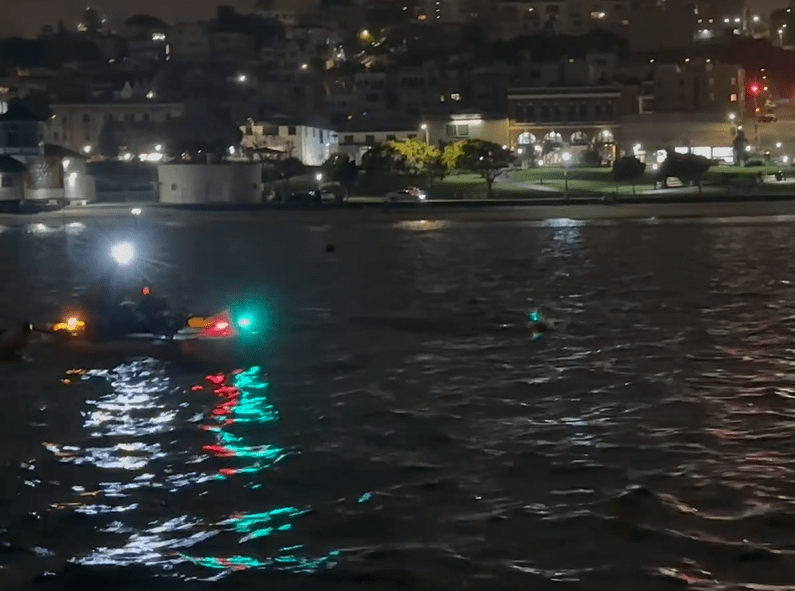
Aquatic Park start, jumping at 12:19am with winds blowing 17 miles per hour
As we approached Alcatraz, I said hello to the first of my people I visit on this swim. A dear swim friend passed away suddenly at 47 years old. We swam countless hours together, and I mentored him as he trained to swim Tahoe width—passing away just two weeks before the swim that was never meant to be. His ashes are at Alcatraz, and I always say hi and ask him for strength for the long night ahead. I had my first feed and got it down quickly. In marathon swimming, we talk a lot about quick feeds, so my goal is to guzzle mine in 30 seconds or less. I use a brand called Neversecond and highly recommend liquid feeds to my athletes—they are the most efficient way to get calories, carbs, fluids, and electrolytes down in under 30 seconds. I was feeding off the main boat rather than the kayak because this swim was also my training swim for the English Channel in July. And this “training swim” was no joke.
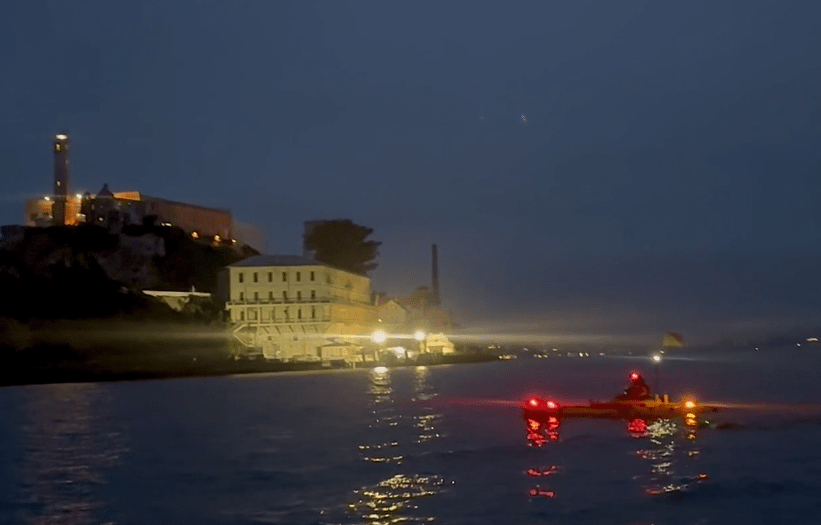
Just approaching the west side of Alcatraz about 30 minutes into the swim
Leg 2 is from Alcatraz to Raccoon Strait at Angel Island. This leg also tends to be easier, but that was not the case for our team on this 8th attempt at RTAI. Midway through the deep channel, I was hit by some sizable whitecaps that rolled me hard. As I breathed to the right, I saw a huge swell with a whitecap slam into John on the kayak. I thought he could easily flip, but he handled it well. A few more whitecaps tried to throw me off my game. As we made our way across the channel and approached Angel Island, the wind eased a little because we were on the leeward side of the North Bay. I knew that once we got to Raccoon Strait, we would be protected from the wind, but working through that chop was definitely straining my shoulders and testing my mental fortitude. My mind started to go to dark places. I was thinking, this is madness. What are we doing out here? I am not even two hours in, and this is miserable. Then my other brain kicked in: Erika, you’ve got this. So many people are watching you. You are raising money for SF Baykeeper. You must finish this. Then I got stung. It felt like an electrical current wrapping around the right side of my throat. What a shock—a little jellyfish sting. I usually do not react to them. Thankfully, the stinging faded after about five minutes, and I carried on. By then I was on the west side of Angel Island and got to say hello to my uncle, whose ashes are there just as you approach Raccoon Strait. On my very first RTAI, this was where I got to experience phosphorescence while swimming for the very first time. Diamonds shot off my fingertips with each stroke. It was magical, and I felt his presence.
Angel Island National Geographic Image
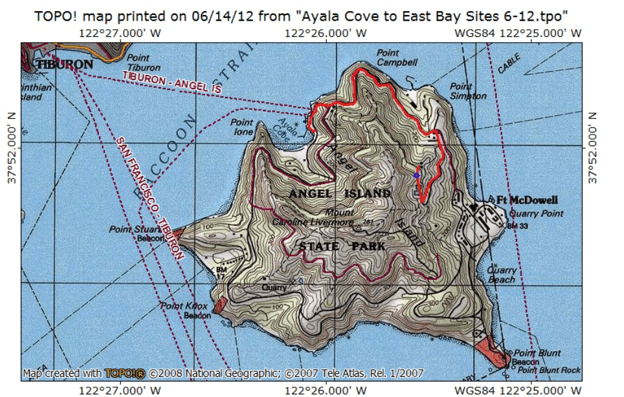
Leg 3 arrives, and I am elated. We have reached Point Stuart, the beginning of Raccoon Strait. It took about 2 hours and 15 minutes to get there, which I only learned later when I read the observer’s notes. I can estimate a little by my feeds, since I eat every 30 minutes, but eventually I lose track of time, and I prefer it that way. You are not allowed to wear a GPS watch, but your crew can share information with you when you feed. The water had warmed from 58 degrees to 61 degrees and I felt the warmer water. And now we were fully protected from the wind. Leg 3 means you get to dial back your effort and reserve energy for Legs 5 and 6. The swim down the strait was a breeze. I got back to a steady bilateral breath and relaxed my stroke, focusing on drills like fingertip drag. I focused on my breath as if I were doing yoga in the water and enjoyed this much-needed reprieve from the wind. We quickly made our way around Point Campbell, getting through the strait in less than an hour.
Now we were onto Leg 4, the east side of Angel Island. This is another leg where you are typically protected from the wind and rewarded with calm water. It was Mother’s Day, and I was swimming RTAI. Now I got to visit my third person: my mom, whose ashes sit in this quiet little nook just on the other side of Point Simpton. She passed away in 2021, and I visit her every year which is one of the main reasons I have decided to do this swim every year. I get to honor my mom. This year I got to wish her a happy Mother’s Day and say I love you from the water as I swam by. My mom taught me to swim as soon as I could walk. She had us taking lessons as children. She was an exceptional swimmer herself and even won an open-water swim in 1956, and I still have her trophy. I think I love swimming at night because I feel connected with those I have lost over the years. I can hear my dad saying, “So this is what you do.” My mom saying, “Aren’t you cold?” My late husband saying, “Let’s GO!” or “Did you win?” So many conversations with loved ones happen when I swim. They give me strength to keep pushing my limits and to keep living my best life. I also think of the people still with me. And on this particular RTAI, I thought a lot about my new partner, my new fiancé, who brought love and joy back into my life when I never thought that might be possible. I smiled into the water quite a few times throughout the swim. He proposed just after the swim.
We were now approaching Leg 5 of the swim. Off to the east, I could see a huge tanker ship heading out toward the Golden Gate Bridge. Before the swim, we had expected very little shipping traffic, which was the best news considering the conditions were anything but ideal. I knew that once we rounded Point Blunt on our way to Alcatraz, we would be fully exposed to the full force of the wind. I was preparing myself for the worst. I later learned my crew was also preparing for the worst. This is when you need to have a few gears left and be ready to use them. We were four hours into the swim, with the toughest two legs still ahead of us. First things first: get to Alcatraz. The wind picked up noticeably as we rounded Pt. Blunt, though not as strong as it had been on the way from Aquatic Park to Angel Island. It had settled some and I was pretty happy about that. I had been praying to my people along the way to calm the wind for me, so I thanked them now that it had dropped into the 8–9 mph range. It was still flooding, so I had to dig deep to get to the east side of Alcatraz. My mind again started drifting to dark places. I was getting bounced around a bit. My left shoulder was a little achy. I found myself thinking, do I really need to do the English Channel? This is just a six-hour swim, and that will be easily double. So I grabbed onto my mantra: “You are a warrior.” I repeated it to myself for 10 or so strokes until my mind settled.
Then that stupid story about the great white attacking a sea lion off the east side of Alcatraz got into my head. I could tell John was trying to push me closer and closer to Alcatraz, but I wanted no part of it. I did not want to be too close to the leeward side of the island. In my mind, that was why the shark attacked there. See, I tell myself there are no sharks in the bay. Well, yes, we have some little guys like leopard sharks, but they are cute. The great whites do not come into the bay. There is some kind of golden force field under the Golden Gate Bridge they cannot pass. And even if a rogue great white did make it through, there is too much silt and too much land mass for them to feed. This story always worked for me—until the night before the swim, when someone asked me about the attack off Alcatraz.
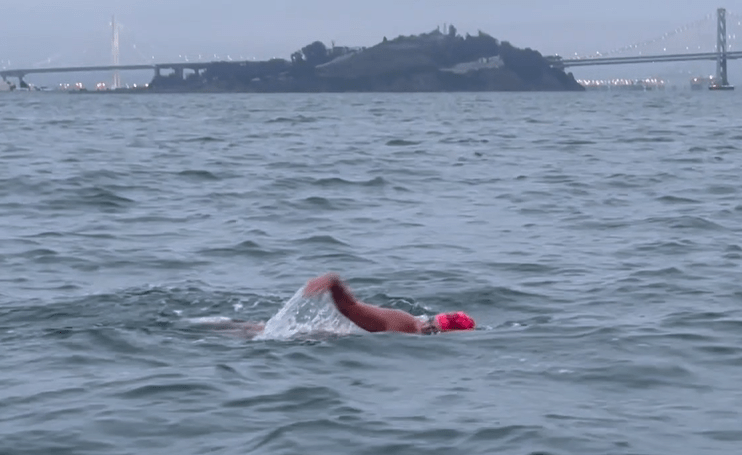
On the Final Approach back to Aquatic Park. Treasure Island and the Bay to the east of me
Finally, an hour later, we were passing Alcatraz and I was feeling much more at ease. We were now in the final leg. Leg 6, and it is just an Alcatraz which brings me comfort. We were still contending with a strong current coming in from the west, and as a result we were being pushed farther east. The ebb had not kicked to assist me in getting to the opening by pushing me west. This was partly my fault, as I had not gotten as close to Alcatraz as I should have. We ended up east of the Aquatic Park cove, and I had to crab my way to the breakwall called the Creakers. Once I got to the wall, which I have swum thousands of times, I knew we were home. I approached the opening of Aquatic Park and was greeted by two swimmers, one of whom is an athlete I am coaching to swim the English Channel. I made my way to the beach and exited the water to complete my 8th Round Trip Angel Island.
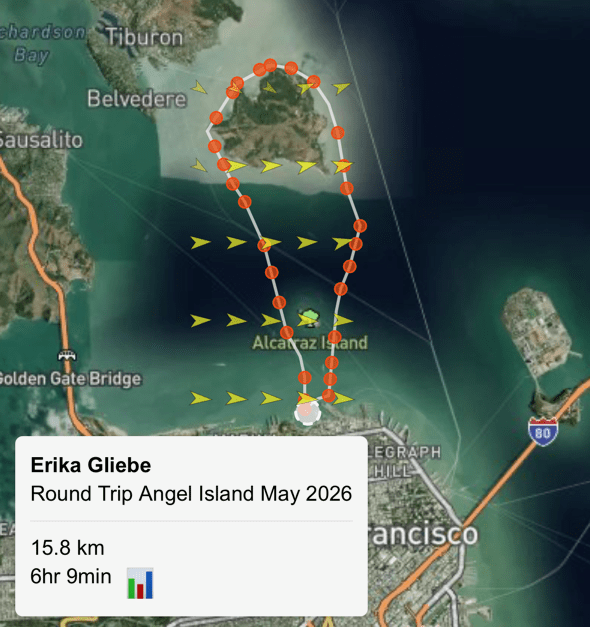
Final map of the swim provided by Marathon Swim Federation
Unofficial time 6hr 14 minutes 30 seconds pending ratification
Through this swim, I was able to support SF Baykeeper and help raise awareness and funds for the tremendous work they do to protect our bay. Please support our local SF Baykeeper!
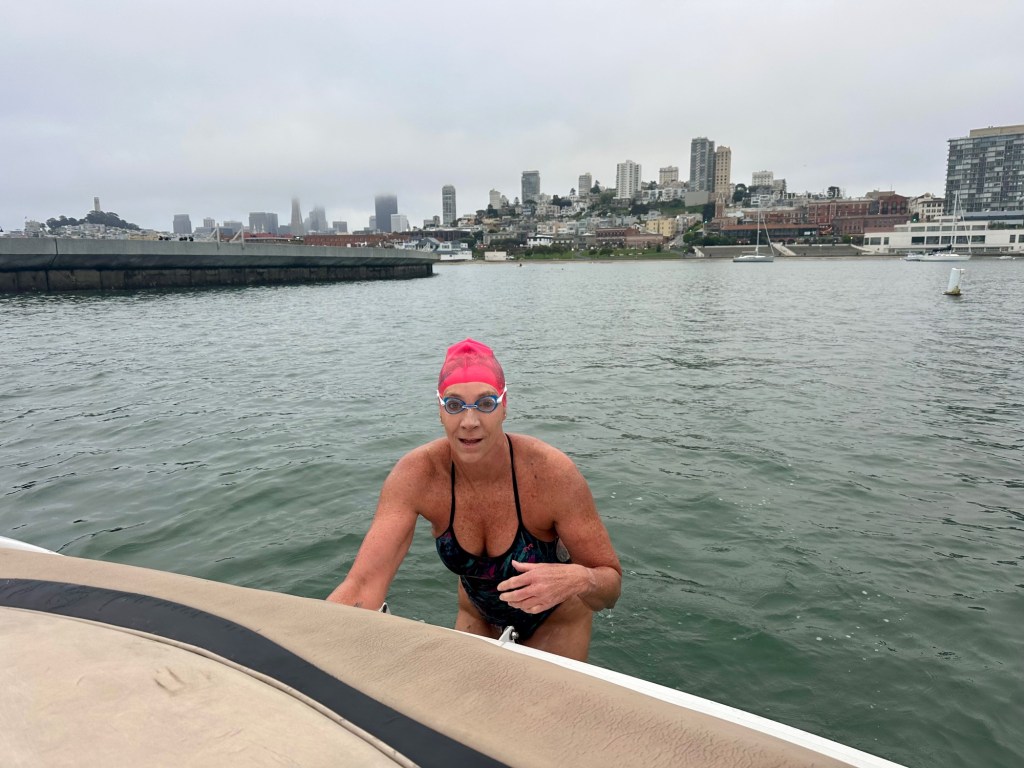
One happy swimmer to have met the challenges thrown her way and completed her 8th Round Trip Angel Island!
Open Water Swim Coaching Available!
Whether you’re just curious about marathon swimming or you’ve been at it for years — I am here to help you succeed.
Marathon swimming is one of the most rewarding journeys you can take, and having the right support along the way can make all the difference.
I love working with swimmers at every stage — those taking their first exciting steps into marathon swimming, transitioning from triathlons to open water and seasoned marathon swimmers who are ready to work through challenges and make the tweaks needed to put you in a position to succeed. Wherever you are, I will meet you there.
And since all coaching is done virtually, distance is never a barrier.
If you’ve ever thought “I wonder if I could do that” – the answer is yes, and I’d love to help you get there.


Comments
One response to “Queen of Angel Island”
Erika, thank you for sharing such an inspiring, beautiful story, especially about your loved ones. It truly makes perfect sense why you are the Queen of Angel Island. The details of your incredible journey were so vivid, I felt like I was right there with you. Absolutely powerful and unforgettable. Congrats, my dear friend AND on your engagement, too. Woo-hoo!
LikeLike